A Clear Label for the Things That Leave the House
A clear label for things that leave the house helps household members find travel-together items quickly and return each group to one visible place.
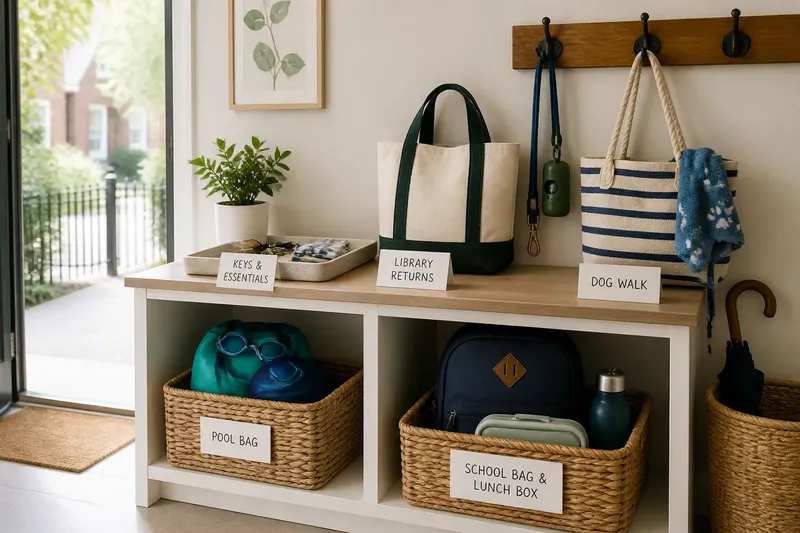
A clear label for things that leave the house starts with one simple rule: group only belongings that regularly travel together, then give each group a visible place. This keeps an out-and-about area legible without turning the hall into a storage system for every object that might be useful someday.
The most useful label names a real bundle, not a broad category. “Dog walk” may describe a lead, waste bags and a small towel that leave together; “outdoors” could mean almost anything. Once the group is clear, choose a home for it that is easy to recognise and easy to put back.
Which items belong in one labelled group?
Watch what actually leaves the house together during an ordinary week. A bundle might be a reusable shopping bag with its folded trolley bag, a swimming bag with goggles and a cap, or a child’s school bag with a lunch box that is packed alongside it. Items do not need to be attached to one another, but their shared use should be regular enough to justify a place as a group.
Keep occasional companions out of the bundle. An umbrella might travel with a work bag on wet days, but if it is also used for school runs and errands, giving it a separate home may make more sense. The aim is not to predict every possible outing; it is to make the routine bundles easy to see and retrieve.
A useful test is whether someone could name the group before searching for its contents. If the answer is a specific outing or purpose, the items may belong together. If the answer is only “things for later”, the category is probably too broad to help.
Should you use a tray, a hook or a shelf?
Choose a visible place that suits the bundle’s shape and the household’s traffic. A tray can hold small, loose items such as keys and a folded cloth; a hook can keep a light bag off the floor; a shelf or open basket can contain bulkier bundles. These are different approaches, not competing rules, and one area can use more than one when each has a clear job.
- Use a tray when the group contains small objects that are easy to scatter. A shallow tray on a console table makes the boundary visible without requiring a label on every item.
- Use a hook when the bag or bundle has a loop and needs to stay ready to lift. Keep the hook within reach of the person who uses it, rather than placing it where it obstructs a doorway.
- Use an open basket or shelf when the group has several pieces or awkward shapes. A basket should be open enough that its contents can be recognised at a glance.
Think of the place as a labelled drawer without a front: the outline of the space helps explain what belongs there. If the tray, hook or basket is hidden behind other belongings, its label cannot do much work.
How should the label name the group?
Use a short phrase that identifies the shared trip or purpose, such as “library returns”, “dog walk” or “pool bag”. The wording should be familiar to the people who use it, not a tidy-sounding category that nobody would say aloud. A label can be written on a card, attached to a basket, or placed beside a hook; it does not need to be printed or decorative.
Make the label visible from the approach, and keep it close to the group’s place. If several people share the area, choose wording that avoids private shorthand. “Sam’s things” may help one person, while “school bag and lunch box” tells everyone what the spot is for.
Say you have a small household where one person carries a library tote and another returns books in a canvas bag. If both sets of books regularly go to the library, place the bags together on one open shelf and label it “library returns”. The expected observable result is that either person can spot the bags and see where they belong after the visit.
Which approach suits your household?
A tray is best for a compact bundle of small pieces and a household that prefers objects to remain visible on a surface. A hook suits a frequently used bag that can hang safely and be lifted in one motion. An open basket or shelf suits a larger collection, or a shared area where several bundles need distinct boundaries.
Choose by looking at the actual items, the available space and who needs to use it. If a bundle is too large for a tray, a tray is not a better choice merely because it looks neat. If the group contains a bag that must hang, a basket may hide it rather than make it easier to collect.
What do people ask about labels and shared places?
Should every item have its own label?
Usually not: label the group’s place when its contents are obvious to the people who use it. Separate labels can add clutter when a simple group name already tells household members what to collect.
What if one item belongs to several outings?
Give the shared item a separate, convenient home if it is used across different bundles. That avoids assigning it to a group where it may be missing when another outing comes around.
How many labelled groups should the area hold?
There is no useful fixed number; keep only the groups that regularly travel together and fit the space without obscuring one another. If people must move one bundle to reach another, reconsider the places or remove a group that is no longer useful.
When should a label or place change?
Change it when the group’s contents or usual user changes, or when the chosen place repeatedly fails to suit the items. A label should describe the household’s current pattern, not preserve an arrangement that has stopped making sense.
How can you choose without over-organising?
Start with the bundles that are easiest to recognise and happen often enough to merit a dedicated place. Give each one a short name, choose a visible location that fits its contents, then leave unrelated belongings out. If a place becomes a catch-all, narrow its label or split off only a bundle that genuinely travels together.
A clear label for things that leave the house is useful because it describes an arrangement people can see and repeat. Keep the group specific, the place visible and the wording plain; the area will remain easier to read than one filled with broad labels and hopeful categories.