Why Small Cues Help Household Routines Stick
Small cues for household routines connect a task to an existing daily event, making its starting point easier to remember and simpler to choose.
Small cues for household routines make a task easier to start by attaching it to something that already happens, such as putting the kettle on or taking off your shoes. The cue is not the task itself: it is the familiar event that reminds you when to begin. Choosing an event that reliably occurs in the right place and order matters more than choosing an ambitious routine.
This is useful when a household task keeps slipping from memory, even though it is brief and worthwhile. Instead of relying on a vague intention to “do it later”, you decide what ordinary event will open the door to it. The best choice depends on where the task happens, who is responsible and how predictable the surrounding moment is.
What makes a useful household cue?
A cue is a repeatable event that comes before a task and gives you a natural starting point. It might be turning off the hob after cooking, arriving home and setting down your keys, or finishing breakfast. The task follows the cue in a consistent order, so the event can prompt it without needing a separate reminder.
Think of the cue as a hook on a wall: it gives one particular thing a place to land. If the hook is hidden or you pass it only occasionally, it will not help much. Likewise, a cue works best when you notice it, can act soon afterwards and do not have to interpret what it means each time.
The task should also be small and clear enough to begin at that point. “Sort out the kitchen” leaves room for hesitation; “put the clean mugs away after breakfast” identifies an action and a moment. You can still do more when there is time, but the cue should point to a manageable start rather than a whole-house project.
Which situation sounds most like yours?
If you forget a task that belongs to one room, what fits?
Choose a cue that already happens in that room, or immediately before you enter it. If you forget to wipe the bathroom basin, for example, finishing your usual handwashing there may be a more visible prompt than an event elsewhere in the house. The close connection makes the next action easier to recognise.
If the task depends on arriving or leaving, what fits?
Link it to an event at the threshold, such as putting your keys in their usual place when you come in. A task involving something you take out can follow putting on your shoes, provided you have access to the item at that moment. Choose the arrival or departure cue that occurs as part of your normal route, not one that depends on an extra trip.
If several people share the task, what fits?
Use a cue that everyone involved can recognise and connect to an agreed responsibility. Clearing the table after the last person finishes dinner may suit a shared kitchen better than a cue tied to one person’s private morning routine. Make clear who does what, since a common cue alone does not assign the work.
If your day changes often, what fits?
Prefer an event that remains dependable across different schedules, such as making your first drink at home, rather than a clock time that shifts with work or school. If no daily event is dependable, pick a cue that occurs whenever the task’s relevant circumstance arises. For instance, a laundry cue can be linked to bringing a full basket to the laundry area, if that is how your household already handles it.
How do you choose a cue that already occurs reliably?
Start by noticing the sequence around the task, rather than inventing a new timetable. Ask what you usually do just before the moment when the task would be convenient. A good cue is already part of the day; adding a new alarm, note or special preparation can turn a simple prompt into another job to maintain.
- Check that it happens often enough. An event that occurs only on occasional visits or special days is a weak match for a routine you hope to remember regularly.
- Check that you notice it. A cue may be dependable in theory but easy to miss if it happens while you are in another room or concentrating on something else.
- Check the order. The cue should come before the task, with enough room to begin. A prompt that arrives after you have left the relevant space is poorly placed.
- Check access to what you need. If the task requires a cloth, basket or envelope, consider whether it is already within reach at the cue. Otherwise, the first action may be finding supplies rather than starting the intended task.
- Check who controls the cue. For a shared routine, avoid depending on an event that only one household member sees or can trigger.
- Check whether the cue is already crowded. If that moment routinely involves several urgent tasks, choose a calmer event rather than adding another demand to it.
These checks help distinguish a reliable cue from one that merely sounds convenient. The right event is not necessarily the most pleasant or memorable; it is the one that occurs where and when the task can sensibly begin.
What if the cue is reliable but the task still feels difficult?
Separate the starting action from the full task. If the cue is taking off your shoes and the task is putting away the post, the first action might simply be placing the letters in a tray rather than dealing with every envelope. A modest start can make the routine easier to resume without pretending that the remaining work has disappeared.
Look for friction between the cue and the action. Perhaps the recycling is awkward to reach, or the items to be put away have no obvious home. Adjust the arrangement if it is straightforward: keep the relevant basket near the place where the cue occurs, or choose a different task that better fits that moment. A cue cannot compensate for an unclear action or inaccessible supplies.
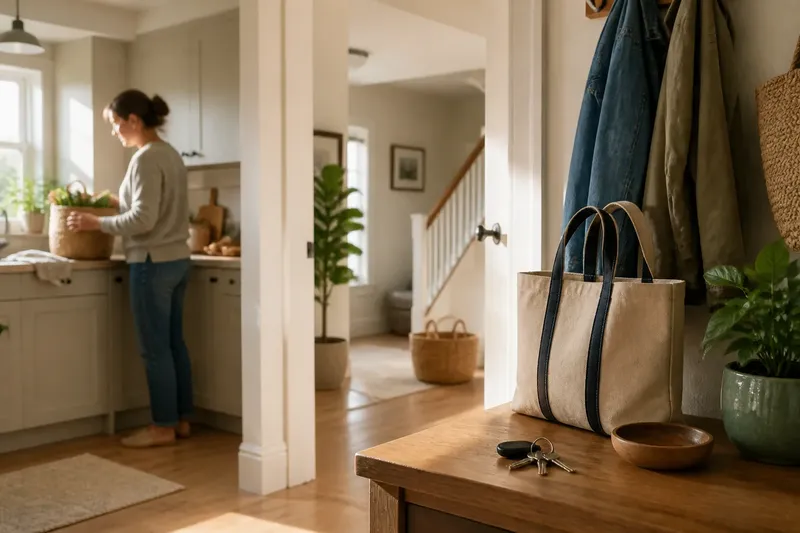
Say you often forget to put a reusable shopping bag back by the door. Imagine choosing the cue of unpacking groceries, then placing the bag in its usual spot as soon as the groceries are put away. The observable result to look for is whether the bag is there when you next prepare to leave; if it is often elsewhere, the cue or storage place may not fit the household’s actual route.
When should you choose a different cue?
Change the cue if it regularly fails to happen, if you notice it only after the useful moment has passed, or if the task keeps being displaced by something more pressing. Do not treat a missed occasion as proof that you lack discipline. It may simply mean the event is less dependable than it appeared, or that the task is too large for the moment you selected.
Also reconsider a cue when it creates conflict between household members. A task tied to one person’s routine can be sensible if that person owns the responsibility, but frustrating if everyone assumes someone else will act. Agree on the owner and the expected action, or choose a shared event that makes the hand-off clear.
If a cue works on some days but not others, ask what changes. Perhaps breakfast happens in different rooms at weekends, or the household uses the kitchen at different times. You may need a more flexible event that remains recognisable across those variations, rather than a second cue for every exception.
How can you tell whether the match is working?
Pay attention to the starting point, not whether the task is completed perfectly. If the cue brings the task to mind and you can begin without searching for the next step, the pairing is doing its job. If you repeatedly remember only later, move the cue closer to the task or choose an event that is harder to miss.
Keep the pairing stable long enough to see its ordinary pattern, but do not preserve a poor fit out of loyalty to the original plan. A useful household routine should sit inside the day as it is lived. When the cue changes because a room, schedule or responsibility changes, the routine can change with it.
Which details should you settle before relying on a cue?
Before you settle on a pairing, make the action precise enough that another person in the household could understand it. “Deal with the recycling” may mean sorting, carrying or putting a container out; “take the paper to the recycling box after clearing breakfast” gives the cue and the next action. Shared clarity reduces the chance that a reminder becomes a disagreement about what was meant.
Consider whether the task has a natural stopping point. A cue is easier to use when the action can be completed or deliberately paused without leaving a mess or creating a new problem. If the task expands unpredictably, define a small first action and decide when the rest belongs, rather than letting the cue silently claim an entire stretch of the day.
Some tasks do not need a daily cue. If an action is tied to a particular household event, such as receiving a parcel or changing a bed, an event-based prompt may fit better than attaching it to breakfast or bedtime. Use the actual circumstance that calls for the task, so the routine does not become an unnecessary ritual.
What if the household’s routine changes?
When schedules or rooms change, review the cue rather than expecting an old pairing to keep working. A new commute might remove the familiar moment of leaving through the front door; a different breakfast pattern might make the kitchen cue inconsistent. Look for an event that has taken the old cue’s place and check that the task remains practical there.
For a temporary disruption, keep the idea simple. If the usual cue is unavailable, you can use the next dependable event that leaves enough time and access to act. Once the ordinary pattern returns, decide whether the original pairing still suits it or whether the temporary alternative has become the better fit.
Small cues for household routines are most useful when they belong to the home’s real sequence of events. Choose one visible, dependable moment; attach a clearly defined action; and adjust the pairing if the task keeps being missed. The aim is not to fill every part of the day with routines, but to make a few necessary tasks easier to remember at the moment they can actually begin.