The Coat Stand Before the Hall Closet
Discover how coat stands and hall closets serve different needs, and choose an entrance arrangement that keeps daily outerwear accessible without crowding the hall.
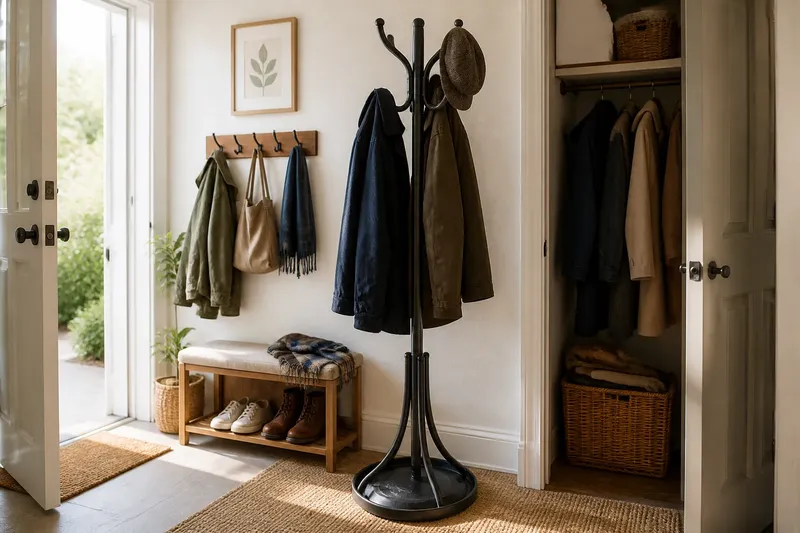
A coat stand gives everyday outerwear a visible place near the door, while a hall closet hides coats behind a door. That difference—not an assumed sequence in which one replaced the other—explains why both forms can still suit a household.
What does a coat stand do differently from a hall closet?
A stand keeps coats within reach and makes it easy to see what is available. A closet encloses garments, which can make the entrance look calmer and keep clothing out of sight, but requires opening a door and finding room inside.
Neither piece needs to do every storage job. A stand can serve the coats in daily rotation; a closet can hold other garments and accessories. Think of the stand as a doormat for outerwear: it receives what is in use without needing to store everything indefinitely.
Which storage option suits your entrance?
Choose according to the space, the route people take through it and how much clothing needs to be close at hand. A freestanding stand needs a stable place that does not obstruct movement. Wall pegs or a rail use no floor space, but need a suitable wall and secure fittings. A hall closet offers enclosed storage if its interior can accommodate the garments and the people using it.
- Freestanding coat stand: If its base sits clear of the walking route and remains stable with the intended coats, use it for daily outerwear; otherwise, choose wall-mounted hooks or another arrangement.
- Wall pegs or a rail: If the wall and fittings are suitable and the hooks do not interfere with doors, use them in a tight entrance; otherwise, look for a freestanding option that does not narrow the passage.
- Hall closet: If garments fit without becoming difficult to retrieve, use it for coats you prefer to conceal; otherwise, keep the daily rotation on accessible hooks and reassess the closet’s arrangement.
- Bench with hooks: If there is room for the bench without blocking the doorway, use it to combine seating and hanging space; otherwise, keep seating and coat storage separate.
- Stand and closet together: If a small group of coats is worn often, keep those on the stand and less-used garments in the closet; otherwise, use whichever single option leaves the entrance clearer and easier to use.
- Wet-coat area: If damp garments can hang without touching vulnerable surfaces, give them room to dry; otherwise, move them to a more suitable drying place and protect the floor from drips.
How can you place a coat stand without crowding the hall?
Notice where people enter, where the door swings and where shoes or bags are set down. Choose a position that is easy to reach but leaves a clear route to the rooms beyond. Check that sleeves will not brush against a wall or another coat.
Consider damp clothing as well. A washable mat can catch small drips, while very wet garments may need a separate place to dry. Follow the stand’s assembly and use instructions, and move it if the base rocks or the hooks make garments difficult to remove.
How should everyday coats be divided between a stand and a closet?
Give each space a clear job. Keep only the outerwear in current use on the stand, with a scarf or hat if it remains easy to reach. Use the closet for garments worn less often or items you prefer to keep out of sight.
Imagine a household with a shallow entrance, a full closet and two coats worn most days. The occupants could leave less-used garments in the closet, fit two suitable hooks near the door and keep the floor clear for shoes. The expected result is that daily coats have an obvious place while the passage remains open; if the hooks make the route cramped, they could instead move the daily coats to an accessible part of the closet.
What do people ask about coat stands and hall closets?
Is a coat stand better than a hall closet?
A stand offers immediate access and keeps daily garments visible. A closet conceals clothing and can hold more, provided its interior is arranged so the coats in use are easy to retrieve.
Where should a coat stand go in a small hallway?
Place it outside the main walking line and clear of door swings. If a stable freestanding base would make the route awkward, consider wall pegs or a rail instead.
Can a coat stand hold bags as well as coats?
It can if the stand’s instructions and stability suit the combined load, and if bags do not crowd out outerwear. If the hooks become congested, move bags to a separate place so coats remain accessible.
How can wet coats be kept from making a mess?
Give damp garments room to drip and dry, and protect the floor with a surface that is easy to clean. If a coat would rest against a finish vulnerable to moisture, dry it elsewhere before storing it there.
The coat stand before the hall closet is best understood as a difference in function, not a claim about a universal historical order: one keeps selected garments close, while the other encloses them. If coats keep landing on a chair or floor, first check whether the existing hooks or closet are easy to reach; changing their position may make the entry routine work better without adding another piece of furniture.